
Discover Jung’s secret phenomenon of unlocking the universe in week 3 of The Artist’s Way

If you read my first installment of “Finding My Way Through The Artist’s Way,” then you’ll know that I’m meandering through the 12-week book study at a much, much slower pace, considering it was originally posted in February of this year. With that in mind, I’ve arrived at week three, which is dedicated to “Recovering A Sense of Power.” The chapter discusses concepts related to anger, shame, synchronicity, as well as growth. I had some major ‘ah-ha’s within this chapter and found myself employing my highlighter frequently.
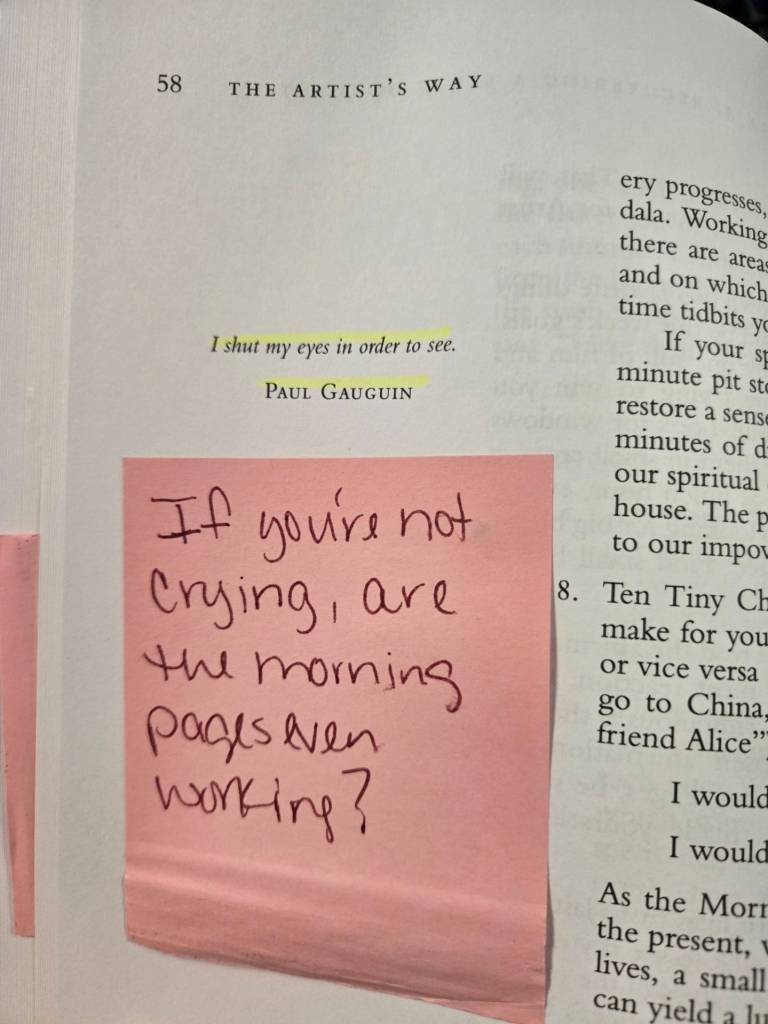
“I shut my eyes in order to see.”
Paul Gauguin
If there is one thing that I can say about this book study, it is that I continue to uncover self-limiting beliefs that I have been blind to. Before I began my review of Chapter 3, I was struck by a quote from Paul Gauguin, the French painter and sculptor. His quote, “I shut my eyes in order to see,” resonated deeply with me and became the inspiration of my Morning Pages. It wasn’t long before I found myself writing erratically, my handwriting changing from legible to illegible, and tears began welling up along my lashes. It was like uncorking a champagne bottle. The contents of my thoughts spewing onto the page faster than I could collect them in a fluted glass. And the result? A revelation that I subconsciously ignore. I’ve been struggling recently with brain fog and exhaustion. I sit down to write but nothing springs forth. My thoughts are disorganized and fuzzy. I try to force the story. I worry about failing because I don’t trust my own intuition. But the real lesson – and ultimate growth opportunity – I’m trying to write with my eyes open. If that doesn’t make sense, I’ll explain.
I’ve always felt that dreaming – whether day dreaming or dreaming through sleep – has been my connection to creativity. As a kid who was not yet diagnosed with Attention Deficit Hyperactivity Disorder (ADHD), I would spend limitless hours disassociating or daydreaming in class. The movie in my mind was always far more interesting than anything my teachers’ had to say. In those undiagnosed days, I wrote short stories in my bedroom and invented characters and imagined worlds. I was dreaming with my eyes open. The reality was that getting lost in my inner world, was much better than listening to my parents argue. My dream world was more vivid and filled with deeper meaning. It has been the source of my creativity and spirituality. So, much like Gauguin, when I close my eyes or step away from this physical consciousness, I see life in perfect detail. So, in essence, I shut my eyes, so I can see. But this makes creating art and moving forward in my goal to authorship a little terrifying. As an adult, I don’t dream with my eyes open anymore. I can’t see the future. So, I must go blindly toward my goal. It’s the act of letting my inner creative child see and create instead of allowing my outer adult to control the narrative.
After excavating this buried truth, I picked up the book and read week 3. And the echoes were tremulously loud. In chapter 3, Cameron deep dives into how our past trauma and unchecked anger and shame can block us as artists. Anger that directs us toward our goals is healthy. Anger that causes us to lash out or ruminate is not. Cameron states, “Anger is the fuel that propels us into our new one [life].” Anger is our internal justice meter and it’s job is to keep us from being wronged. Cameron goes on to reveal how shame is used to limit us. Adults with a background of childhood trauma may experience this more severely. Reading this section of the chapter, really resonated with me as I am a product of an unhappy marriage and began to feel more like a therapy session than a book study. But I’m reminded of early chapters that identify our artist selves as our inner creative child. My own inner creative child has struggled with making others uncomfortable and as a result stifled my own creativity, and thus potential. It led me to ponder, is the root of imposter syndrome really shame? Someone, somewhere, made us feel like we were less than and we are forever convinced of our shame. Cameron explains how someone who has dealt with this may even struggle to complete creative projects. And that struggle is real. I look at my own work in progress and wonder if it’s a waste of my time. If it will be good enough? If I can even put my own name on it or if it should be published under a nom de plume? How can we as artists expose our vulnerability and not hide in shame? Cameron’s answer: create art anyway. Give yourself the love and support that you needed when you were young.
“Whatever you think you can do or believe you can do, begin it. Action has magic, grace, and power in it.”
Goethe
The final ‘ah-ha’ for me was in exploring the viability of synchronicity. Essentially, Cameron says that the Creator God gives blessings to those bold enough to bare their soul. As we create, the universe conspires to help us succeed. Cameron’s pairing of evidence from Jung and Goethe lend credibility to the phenomenon. Cameron explains that most artists ignore “the possibility of an intelligent and responsive universe, acting and reacting in our interests.” Some call it the stars aligning. Others call it coincidence. However, it is hard to ignore when things just fall into your lap. I believe we all have moments that seem too good to be a coincidence. As an atheist, I struggle with calling it God’s Will™️. But that’s another area of growth that has evolved from this book study. My understanding of my own spirituality – as complex as it is – has began to shift to acknowledge the unseen. Maybe the Universe does conspire in our best interests. Or maybe we get more of what we focus on. Either way, I’m compelled to experiment. To quote Goethe, “Whatever you think you can do or believe you can do, begin it. Action has magic, grace, and power in it.” If Goethe can believe in the magic of our actions, then perhaps the only thing left to do is set our intentions. Claim it. Manifest it. Make it. Do it. Create. Whatever inspires us and brings us closer to the desires in our heart and the fires in our belly.
The revelations from this chapter seem unending. There were far too many nuggets to mention them all. However, my chief take-away is that when we put in the work for our dreams, the Universe will match energy. Becoming an unblocked artist requires lots of soul searching, lots of therapy, lots of showing up to the page, and most importantly, lots of closing our eyes in order to see. We must do the shadow work to release the trauma that holds back our inner creative child. When we do, the Creator God, whatever you call them, is there with exactly what we need.
Thank you for reading! I’d love to hear your thoughts. Have you read Julia Cameron’s book, “The Artist’s Way?” If so, what were your golden nuggets? Comment below with your key take-a-ways.
If you haven’t read Julia Cameron’s book: use my affiliate link to purchase your copy.
If you are interested in receiving my content, please subscribe. Thank you!
