This one quote from Julia Cameron rewired my perspective.

About a month ago, I saw a Facebook post from my friend (and published poet), Britt Matthews, gathering interest in a book study for “The Artist’s Way” by Julia Cameron (use my affiliate link to purchase your copy). To be honest, I’d never heard of the book, but the opportunity piqued my interest – probably more due to my friend’s reputation for her commitment to cultivating her art and encouraging a community of artists.
In my journey to become a published author, I’ve set some goals for myself this year, as a sort of “resolution.” I know. I know. I cringe just calling it that because New Year’s Resolutions never seem to work out. There are countless horror stories of people who resolve to get fit as a New Year’s Resolution, even going as far as joining a gym and hashing out the cash for a monthly membership. Then canceling the membership months later because they stopped going to the gym by February. For that reason, I’ll reframe my terminology – this is more like a goal, not isolated to this one year. But more of a commitment to my art and attaining the life that I want to lead by investing in myself as an artist. That goal is simply putting myself out there more and doing “writer” things. For example, like attending events with like-minded individuals and building a support system for the days when it seems like my goal of becoming published will never happen. I’m fortunate to have an active writer community locally. However, I’m my own worst enemy, because I don’t participate. Long story short, imposter syndrome usually keeps me from joining in. So, when Britt announced a low-stakes opportunity to get involved with other artists, I jumped at the chance.
For those of you who aren’t familiar with Julia Cameron’s book, it aims to “guide readers in uncovering problems areas and pressure points that may be restricting their creative flow and offer techniques to free up any areas where they might be stuck, opening up opportunities for self-growth and self-discovery (Amazon).” The book is structured like a 12-week course guiding the reader through the various stages of recovery. Needless to say, my timeline for completing the assigned tasks will be different from the author’s intention. To be honest, I am taking this book study at a sloth’s pace considering that I began this book almost a month ago and I have only gotten through Weeks 1 and 2. However, I feel that taking it slow will lead to a greater understanding of the concepts and deeper integration of the tasks.
My goal for writing this post is two-fold: first it is a well-meaning effort to keep myself accountable for my progress through the course, and second it is another step toward building a community of artists, having a support system, and doing “writer” things. After all, they say this is where the writers are. If you have read the book, please comment below. I’d love to hear about your experience – including your biggest struggles and your most rewarding ‘Ah-ha’s.’
“There is no change without action. There is no action without effort. There is no effort without intention.”
One of the caveats of the course, is what’s referred to as Morning Pages. I was writing my recommended three pages when I experienced a revelation. Just as the book warns, my ramblings in the Morning Pages, like most everyone else’s, are focused on struggles, negativities, or problems that need solutions. It tends to be the things that bug me that my ADHD brain needs to rattle off first before any coherent thought can occur. Through this process, I discovered that I’ve been in a functional freeze for a few months and have grown resentful of the stress that the issue has caused within my home. Without getting too in-depth about the issue, I decided that I had been dormant long enough and needed to set my intentions in order to create a much needed solution to the problem. Through the pages, I took ownership of my part in the problem. And set some intentions for how I would resolve the issue. In allowing my thoughts to flow through a stream-of-consciousness onto the page, I discovered this nugget: “There is no change without action. There is no action without effort. There is no effort without intention.” It reminded me that I need to be specific and purposeful in my thoughts and actions.
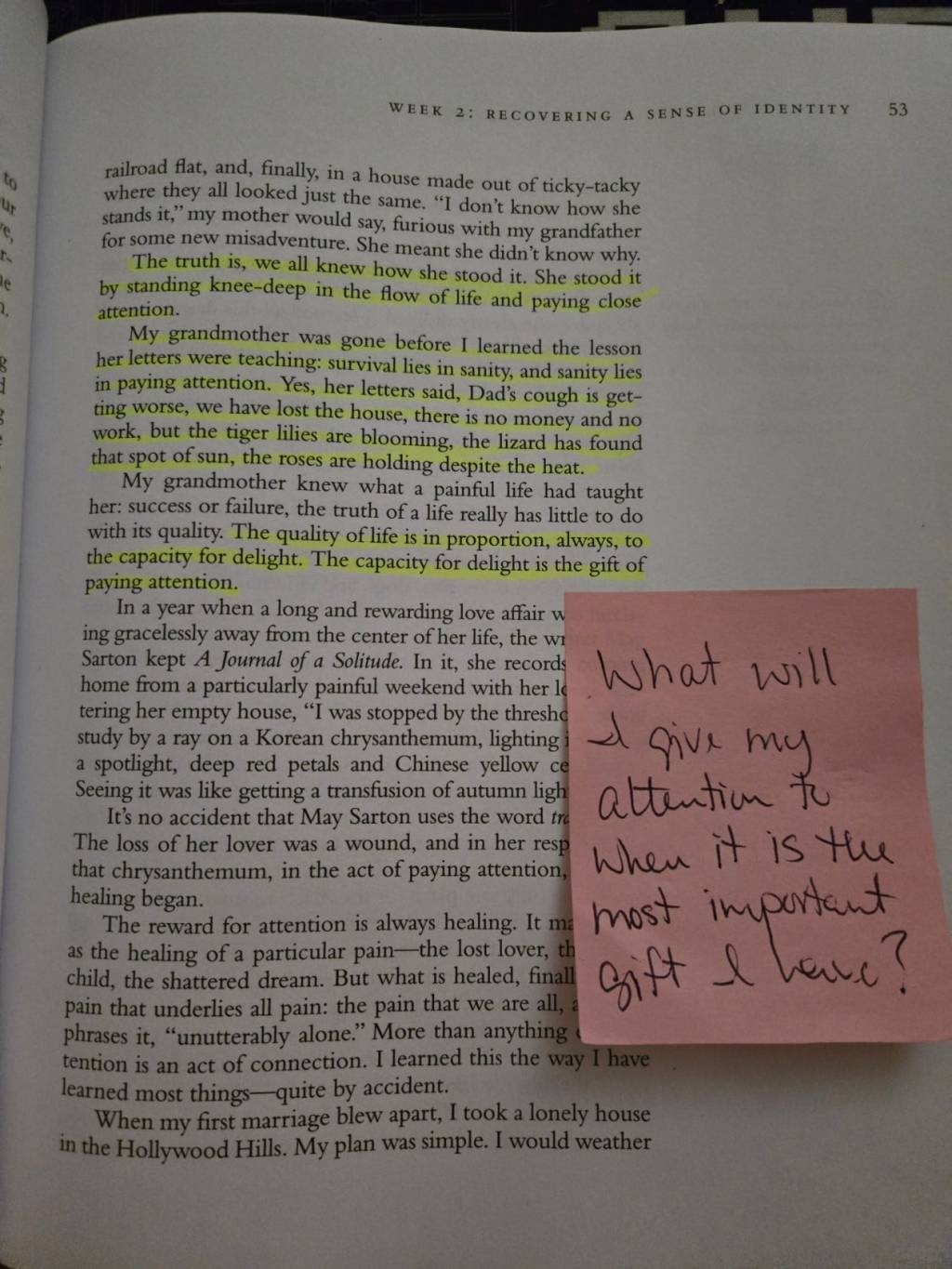
With this in mind, I set my intentions to show up for my artist self. I have another meeting with the book study tomorrow, and I wanted to be prepared to share some of my take-a-ways. So, I picked up the book and read Week 2. Julia Cameron might say that the Divine Creator was speaking through my Morning Pages and through my reading today. However, as an atheist, I struggle with the concept of a higher power manifesting knowledge on my behalf. But I certainly can’t argue with the common theme that I discovered by reading Week 2. I’ve included a photo (above) of my annotations. This chapter in the book is dedicated to recovering your sense of identity and how that relates to where our attention lies. My biggest ‘ah-ha’ was when Cameron explains, “The quality of life is in proportion, always, to the capacity for delight. The capacity for delight is the gift of paying attention.” This struck a note with me as I feel like it aligns with my earlier revelation through the Morning Pages. For months, I’ve been focusing my attention on problems, seemingly straining my brain to find solutions, which only lead to overthinking and shutting down. The overwhelm of not being able to allow my thoughts to flow freely and giving myself the grace to accept the situation as it is. The Morning Pages allowed me to relax and get in touch with my subconscious. And from that, I was able to set my intentions and take action. I focused my attention on the things that I could do.
“The quality of life is in proportion, always, to the capacity for delight. The capacity for delight is the gift of paying attention.”
– Julia Cameron, “The Artist’s Way”
When I consider how many things beg for my attention on a daily basis, it is no wonder I’ve been overwhelmed. As a high school English teacher, my days are filled with admin pushing improved test results, students reaching out for someone to acknowledge them, and coworkers who need someone to commiserate with. It’s a high energy, high stress job. But when I pause to consider where my attention goes, and how I can reframe my focus in order to achieve my goals as a writer, I come back to one question. What will I give my attention to when it is the most important gift I have? My heart says my attention should be set on finishing my manuscript. My attention should be laser focused on participating in the opportunities that lead me to the creative life I strive for. My attention should be reserved for accomplishing the goals that mean the most to me.
Thank you for reading! I’d love to hear your thoughts. Have you read Julia Cameron’s book, “The Artist’s Way?” If so, what were your golden nuggets? Comment below with your key take-a-ways.
If you are interested in receiving my content, please subscribe. Thank you!
